
I used to think in algorithms; AEGEE taught me to think in relationships. As a Computer Science student stepping into youth leadership, I realized UX isn’t just about interfaces—it’s about trust, clarity, and the choreography of people working toward something bigger than themselves.
My path began at home, serving as a Board Member of AEGEE‑Kastoria as IT Responsible. Keeping systems dependable and translating local needs into usable tools was my first lesson in service design: show up, listen closely, and make complexity feel simple. That mindset followed me into a Brussels coordination meeting where we aligned roles, risks, and rituals to organize two upcoming Agoras. It felt like designing an enterprise experience—quietly stitching together human intentions so thousands could move smoothly through decisive moments.
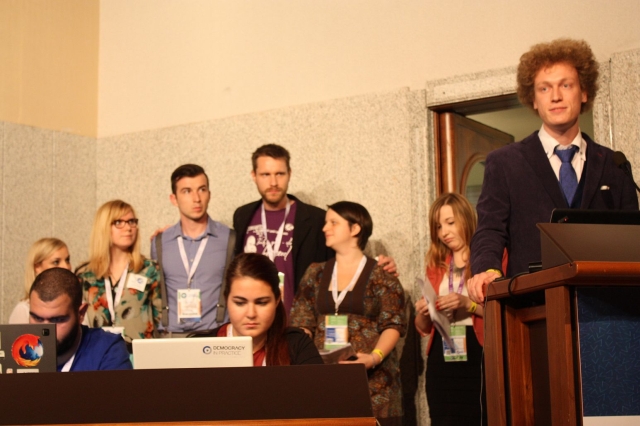
When the curtain lifted in Spring 2014 at Agora Patra, I stepped into a forest of cables—roots and vines carrying the pulse of different requests from different people, each tug a signal, each knot a potential outage. The presentation system was a temperamental instrument that wouldn’t tune on the first try, so we listened for the hum beneath the noise, coaxing it into harmony while we braided loose ends into a single spine—labeling, taping, rerouting so momentum wouldn’t trip over its own feet. By the time Agora Cagliari arrived later in 2014, we could read the cables like sheet music: documentation was our map of the underground, calm communication the insulation that kept sparks from jumping, and reliability the steady current that made the whole stage glow.
Beyond the events, I served as IT Administrator for AEGEE’s internal membership system across Europe. That work taught me the backbone of UX at scale: data integrity, privacy, and designing for edge cases so the experience feels invisible—because everything simply works. Mentoring as a Subcommissioner for AEGEE‑Ioannina and AEGEE‑Patra added another layer: stakeholder management across cultures, the humility to adapt, and the conviction that good systems start with good relationships.
I stayed rooted in storytelling and inclusion through local organizing, including “Ragkoutsaria 2014: The crossroad of Greek and Balkan culture.” Logistics met narrative, and the brief was simple—make everyone feel welcome. And the result was something like this:
Collaboration stretched further through work with the Σύλλογος Ατόμων με Σκλήρυνση Κατά Πλάκας Καστοριάς (Association of People with Multiple Sclerosis in Kastoria), supporting agreements for the Western Macedonia—Kastoria department with the Bionian cluster (private company). Accessibility stopped being a checkbox and became a design principle. In 2014, we co‑organized at the TEI of Western Macedonia (Kastoria) the forum “Supply Chain, Total Quality and New Technological Challenges—Crisis and Preconditions in the Labor Market,” alongside AEGEE‑Kastoria, the Career Office, and the Inter‑Institutional MBA—a masterclass in systems thinking and resilience. I also organized and presented “Creating Music via Electronic Programs and Equipment: Basic Steps for Beginners,” where composing and prototyping felt like the same craft: try, listen, iterate. With the University of Western Macedonia, we ran numerous single‑day seminars that sharpened facilitation and learner‑centered design.
Looking back, AEGEE was my living lab. Code taught me logic; AEGEE taught me belonging. And the best part wasn’t just the roles or the systems—it was the people. Along the way, the most unique organizers, activists, technologists, and artists stopped being titles and became friends—the kind who show up when the Wi‑Fi drops, the deadline looms, or life simply calls. That’s the UX I strive for: experiences that work, because they’re built with—and for—each other.
